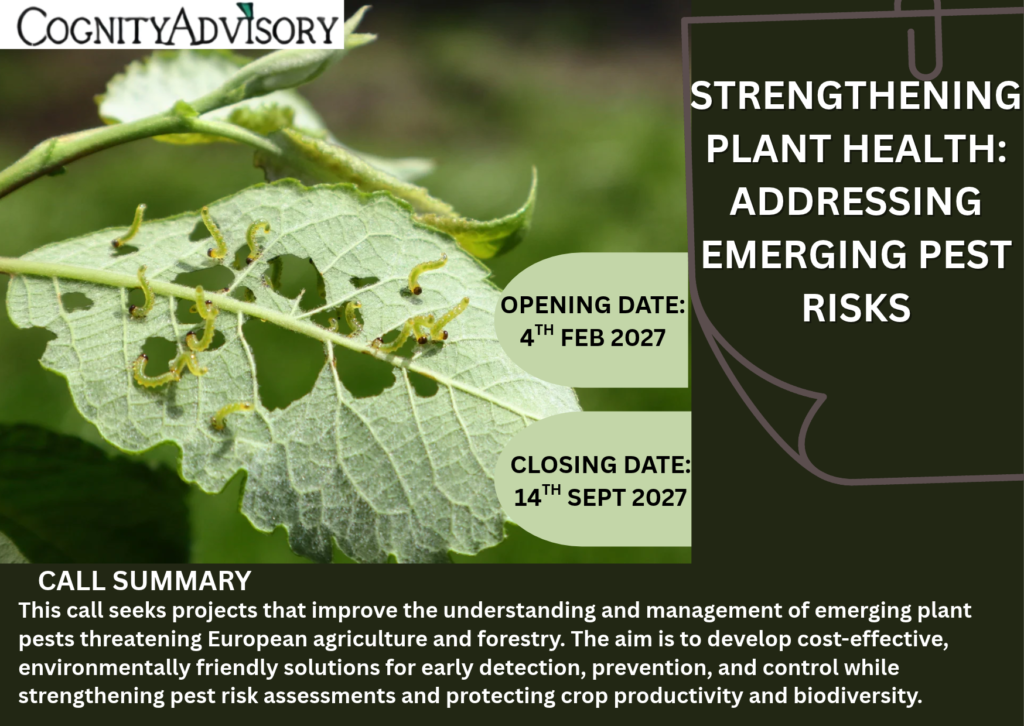
HORIZON-CL6-2027-02-FARM2FORK-01-two-stage
General information
Programme
Horizon Europe (HORIZON)
Call
Call 02 – two-stage (2027) (HORIZON-CL6-2027-02-two-stage)
Type of action
HORIZON-RIA HORIZON Research and Innovation Actions
Type of MGA
HORIZON Lump Sum Grant [HORIZON-AG-LS]
Forthcoming
Deadline model
Two-stage
Planned opening date
04 February 2027
Deadline dates
08 April 2027 17:00:00 Brussels time
14 September 2027 17:00:00 Brussels timeTopic description
Expected Outcome:
Project results are expected to contribute to all of the following expected outcomes:
- improved understanding of key drivers of plant pest emergence, including the influence of climate change, ecosystem degradation and globalisation;
- cost-effective and environmentally friendly preventive and/or curative measures for managing the targeted plant pest(s) are identified, validated, and made available to farmers and forest owners for effective pest management;
- robust scientific support is delivered to strengthen decision-making processes.
Scope:
Effective plant health measures are essential for protecting agriculture and forestry, ensuring food security, preserving ecosystems and biodiversity, and enabling safe and sustainable trade. This action aims to strengthen plan health by addressing emerging plant pests[1], whether regulated or unregulated, introduced or native, that currently pose, or are likely to pose, significant socio-economic and/or environmental threats to agriculture and forestry within the EU and Associated Countries.
Proposals should target one or more emerging plant pests[2], taking into account the increasing risks driven by climate change, biodiversity loss, land use changes, globalisation and other contributing factors, with the exception of plant pests targeted in Horizon Europe[3].
Proposals should:
- enhance understanding of pest(s) biology, introduction pathways, mechanisms of spread, thereby reducing uncertainties and lack of data in pest risk assessments;
- develop rapid, safe, and cost-effective tools and methods for preventing introduction and spread of the pest(s); this includes early detection, surveillance, treatment, and (bio)control measures (including innovative agro-ecological or forestry management practices), in line with sustainable and integrated pest management;
- assess the social, economic, and environmental impacts of plant pest(s) establishment and spread on farmers and/or forest owners and develop strategies to mitigate these impacts effectively;
- contribute to the identification of resistant and/or tolerant traits.
Proposals may provide financial support to third parties (FSTP) to, for instance, develop, test and demonstrate tools and methods for early detection, surveillance, treatment, and (bio)control measures.
Proposals must implement the multi-actor approach including a range of actors to ensure that knowledge and needs from various sectors such as research, plant health services, farming/forestry sectors, advisory services, and industry are brought together.
International cooperation with countries affected or threatened by the same pest(s) is strongly encouraged. Results should address diverse farming systems/approaches, including conventional and organic farming. When relevant, consider a gender sensitive and inclusive approach and the specific needs of groups in vulnerable situations.