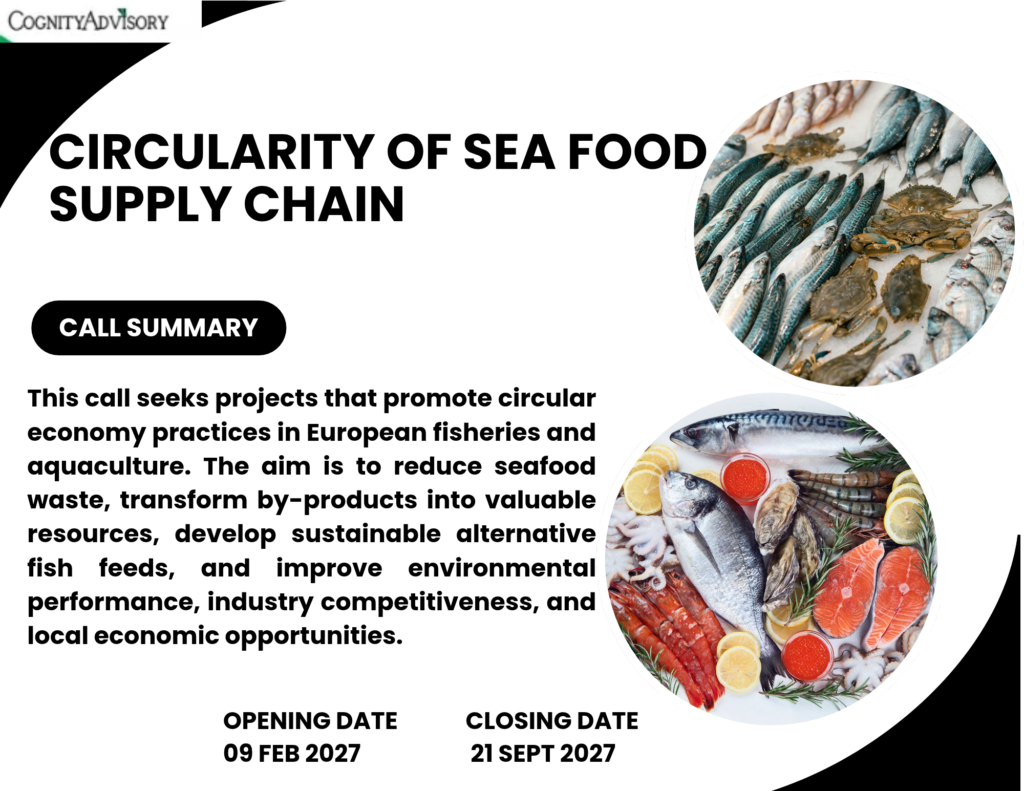
HORIZON-MISS-2027-03-OCEAN-02
General information
Programme
Horizon Europe (HORIZON)
Call
Supporting the implementation of the Restore our Ocean and Waters Mission (HORIZON-MISS-2027-03)
Type of action
HORIZON-IA HORIZON Innovation Actions
Type of MGA
HORIZON Action Grant Budget-Based [HORIZON-AG]
Forthcoming
Deadline model
Single-stage
Planned opening date
09 February 2027
Deadline date
21 September 2027 17:00:00 Brussels timeTopic description
Expected Outcome:
Project results are expected to contribute to all of the following expected outcomes:
- Measurable improvements in the competitiveness and increased environmental sustainability of the EU’s fisheries and/or aquaculture sectors by integrating circular economy principles;
- Minimized and better managed waste products derived from fisheries and/or aquaculture sectors as well as improved reutilization and reduction of by-products;
- Reduced existing barriers preventing the implementation and development of circular principles in seafood chains, such as the cost of advanced processing technologies, regulatory hurdles, lack of collaboration across the different seafood supply chain actors or limited market demand and acceptance;
- Measurable socio-economic benefits for local stakeholders and communities involved in the seafood processing chain.
Scope:
Proposals under this topic are expected to show how activities and results will contribute to achieve Mission objective 2 – prevent and eliminate pollution of marine and freshwaters and Mission objective 3 – Sustainable, carbon-neutral and circular blue economy.
The goal is to improve the competitiveness of the European seafood industry along the value chain while ensuring optimal resource use and minimising environmental impacts by applying circular economy principles to the aquaculture and/or fisheries sectors.
In this topic, seafood covers marine or freshwater edible organisms, including seaweeds and algae.
Projects under this topic are relevant to the Circular Economy Action Plan, the EU Bioeconomy Strategy, the EU Algae Initiative, the EU Action Plan Towards Zero Pollution, the European Ocean Pact and the Mission objective of making the blue economy sustainable.
The circular approach in seafood supply chain can be applied by the reduction and better management of waste products and/or by improving the valorisation of fisheries and aquaculture by-products which can be used as input for other industries. The aquaculture sector can also explore more sustainable and circular practices as following the example of the Integral Multi-tropic Aquaculture (IMTA) or the diversification to lower trophic species. Another example is the use of innovative organic feed from fisheries bycatch, agriculture products or low-trophic species, as alternatives to traditional fish meal and fish oil, which will reduce dependency on wild fish stocks.
Proposals under this topic should test and demonstrate the technical feasibility, the economic viability and the effectiveness of innovative solutions that improve the circularity and the sustainability of the seafood chain of aquaculture and/or fisheries sectors. These circular solutions should also provide socio-economic benefits to the local communities and stakeholders across the seafood value chain by creating jobs and business opportunities, and enhance skills at local level.