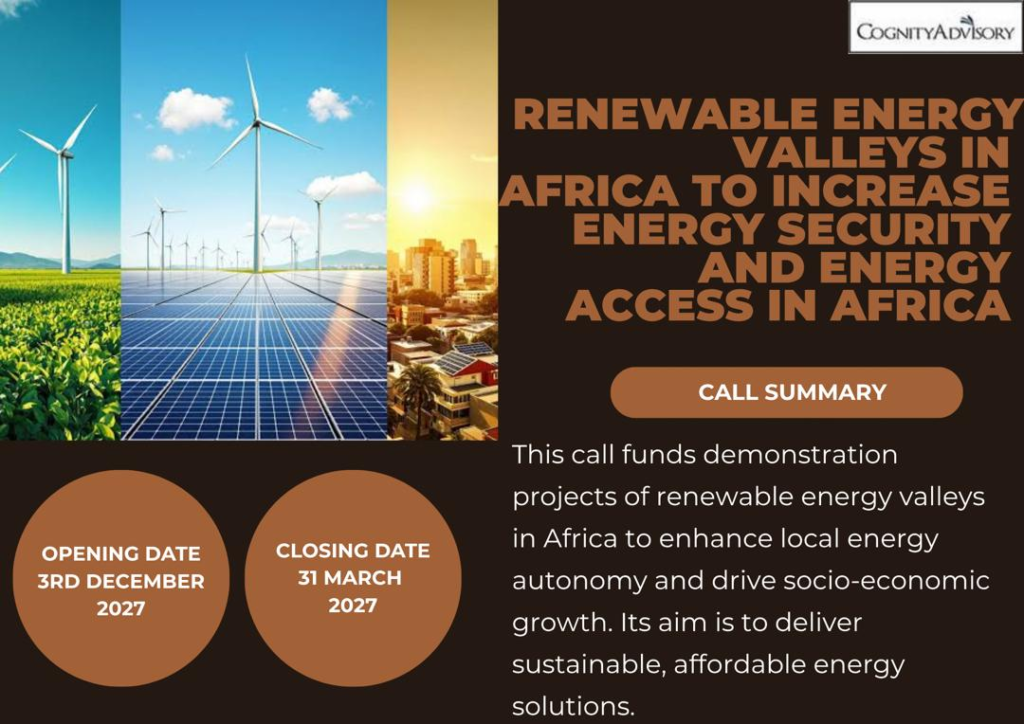
HORIZON-CL5-2027-02-D3-10
General information
Programme
Horizon Europe (HORIZON)
Call
BATTERIES and ENERGY (HORIZON-CL5-2027-02)
Type of action
HORIZON-IA HORIZON Innovation Actions
Type of MGA
HORIZON Action Grant Budget-Based [HORIZON-AG]
Forthcoming
Deadline model
single-stage
Planned opening date
03 December 2026
Deadline date
31 March 2027 17:00:00 Brussels timeTopic description
Expected Outcome:
Project results are expected to contribute to all of the following expected outcomes:
- Strengthening of the joint EU-AU Climate Change and Sustainable Energy Collaborative Partnership efforts, with emphasis on improving the visibility of EU Science Diplomacy actions in Africa and supporting Global Gateway Strategy priorities.
- Acceleration of the achievements of the African countries’ targets of the Paris Agreement.
- Increase the roll-out of local or regional renewable energy system solutions for electricity, heat and fuel needs and contribute to a fair trade between Africa and Europe.
- Create new sustainable silks and jobs linked to local or regional renewable energy system value chains and enhance economic growth in local or regional African communities.
- Increase the readiness, reliability, performance and affordability of local or regional renewable energy system solutions in Africa.
Scope:
Renewable energy valleys are understood as decentralised renewable energy systems that offer a viable and efficient solution to the challenges mentioned above. For example, local production and consumption, reduced transmission and distribution losses thanks to the reliance on local networks for energy needs, greater operational flexibility and reduced dependence on expensive fuel imports all contribute to a higher energy autonomy, a more secure supply, and lower, more stable overall energy costs, including for individual citizens. In addition, this alleviates a part of the load on the centralised grid and avoids blockages by the capacity of the grid.
The action should cover either urbanised or rural contexts in Africa. It should contribute to providing sustainable renewable energy access and creating other socio-economic benefits, such as improved health, economic wealth, skills and jobs, while reducing the stress on the environment, notably on biodiversity, adopting a Water Energy Food Ecosystem (WEFE) Nexus approach and following methods of the circular economy [1].
Actions are expected to cover the design, construct, commission and operate the demonstration installation, including aspects of energy needs and energy consumption, of grid stability and grid reinforcement in the region concerned. Actions should also develop and implement a tailored value chain approach, identifying the most suitable manufacturing value chains, on the basis of the local context, local material supply chain(s) and local workforce, with the objective of ensuring sustainable local economic development. A gender sensitive approach could further support the activities, taking into account relevant groups in a vulnerable situation such as rural communities, and women.
African SMEs are expected to play an important role in the overall value chain and to contribute in the identifying the needs. Participation of EU private sector actors should also be encouraged in alignment with the priorities of Global Gateway Strategy. Actions should also include the identification of technical, vocational and educational needs of the workforce and propose relevant training and qualification activities. Actions should finally define a market and business strategy that could take into consideration funding from European and international financial instruments and development finance programmes to ensure impact through a quick and viable commercial take-up of the technological solution demonstrated.
Social innovation should be considered. The business plan is expected to include appropriate consideration of available financial support instruments (local, regional and/or international) to enhance the speedy market deployment of the solution. The aspects of regulatory environment and local communities’ governance needs and/or impacts are also to be considered.
Proposals are expected to include a life cycle analysis showing the impact of the proposed solutions when compared to other technologies/solutions on the environment, on climate change targets and on the social and the economic dimensions, taking a cradle to grave viewpoint, encompassing the design and the operation phases. The life cycle analysis should take a cradle to grave approach. Proposals should adopt a circular economy approach. Whenever negative impacts have been identified, mitigations measures are expected.
As the demonstration installation will be located in Africa, relevant African partners have to participate in the implementation of the project. A balanced involvement in the activities of the projects of European and African partners will be considered an asset in the evaluation. Actions should also participate in and contribute to the African Union[2] – European Union collaborative research action on Climate Change and Sustainable Energy, in particular through cooperation/collaboration with the project LEAP-SE (www.leap-re.eu). Alignment with Global Gateway ongoing activities on renewable energy in Africa should be also prioritized, including the collaboration with EU Delegation and EU private sector actors in Africa, as well as with the Partnership on Food and Nutrition Security and Sustainable Agriculture (FNSSA) and Cluster 6’s topic HORIZON-CL6-2027-02-FARM2FORK-02-two-stage.
Lesson learned from the implementation of European Renewable Energy Valleys projects should be considered. These projects are REFORMERS[3] and CRETE VALLEY[4].
Proven access to necessary land and / or permits for operation at the time of application and / or convincing risk management regarding delayed availability of land or permits are expected in the proposal.
https://ec.europa.eu/info/funding-tenders/opportunities/portal/screen/opportunities/topic-details/HORIZON-CL5-2027-02-D3-10FOR MORE INFORMATION: