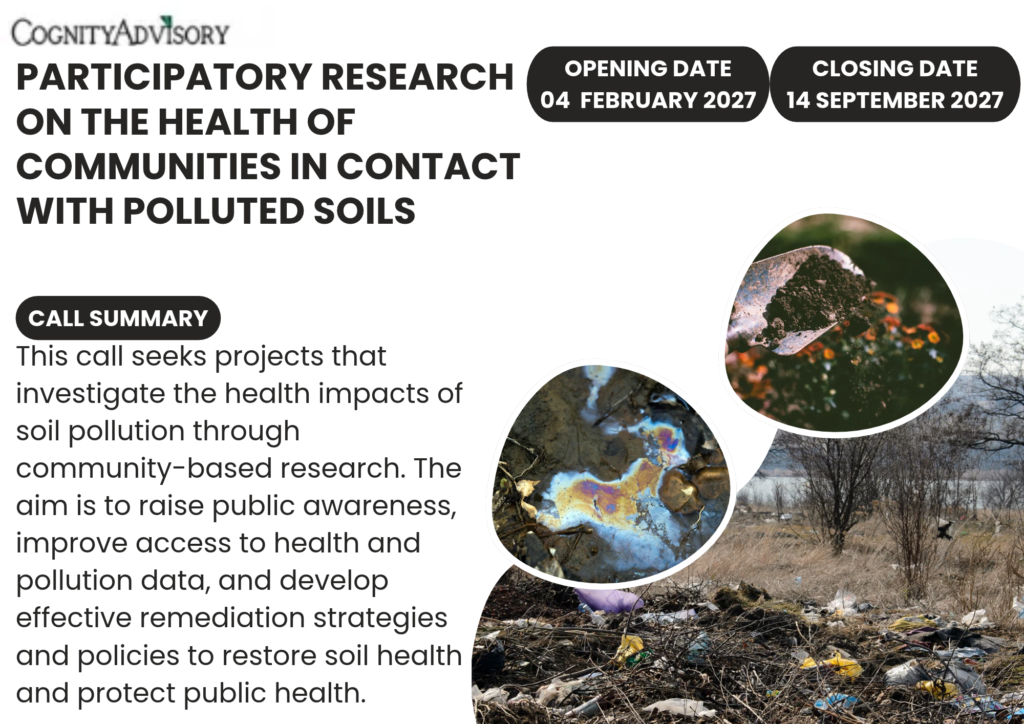
HORIZON-MISS-2027-05-SOIL-04-two-stage
General information
Programme
Horizon Europe (HORIZON)
Call
Supporting the implementation of the Soil Deal for Europe Mission (HORIZON-MISS-2027-05-two-stage)
Type of action
HORIZON-RIA HORIZON Research and Innovation Actions
Type of MGA
HORIZON Lump Sum Grant [HORIZON-AG-LS]
Forthcoming
Deadline model
Two-stage
Planned opening date
04 February 2027
Deadline dates
08 April 2027 17:00:00 Brussels time
14 September 2027 17:00:00 Brussels timeTopic description
Expected Outcome:
Activities under this topic will help progress towards the objectives and targets of the Mission Soil and should contribute to meeting the relevant targets of the EU Soil Strategy for 2030 and the Zero Pollution Action Plan, as well as to the Sustainable Development Goals[1].
Project results are expected to contribute to all the following expected outcomes:
- improved citizen awareness on the connection between soil pollution and human health and how to manage, adapt to, and mitigate risks;
- increased public access to FAIR[2] data and knowledge on soil pollution and the emergence of human diseases and other health outcomes;
- policymakers enforce the implementation of long-term, sustainable solutions that enhance soil health, restore the environment, and protect public health.
Scope:
Across the European Union, an estimated 2.8 million land sites are potentially contaminated. Exposure to soil pollution poses serious health risks and is estimated to contribute to around 500,000 premature deaths worldwide each year[3]. People can be exposed directly, through skin contact or inhalation of dust from polluted soils, or indirectly, by consuming contaminated food or drinking water.
Despite numerous studies clearly demonstrating the harmful effects of soil pollution on human health[4], public awareness of the risks associated with contaminated sites remains limited, as does the due diligence of polluting entities, and the response of public authorities.
Community-based participatory research[5], which directly involves populations living and/or working in polluted or potentially[6] polluted sites, will help, to identify and map human diseases and health outcomes driven by soil pollution, and increase public awareness of the environmental and health the risks related to soil pollution.
Proposals should:
- implement community-based participatory research activities to engage with populations living or working in close contact with polluted (or potentially polluted[7]) sites to identify and map human diseases and other health outcomes and their incidence in these areas;
- consider and explore direct (e.g., skin contact with soils) and indirect (e.g., consumption of contaminated food, psychological impact of living near contaminated sites) soil-related drivers of human disease and ill-health as relevant;
- engage private entities with industrial operations in polluted sites and which work with potential pollutants (including substances of concern), involving them as stakeholders in the research to jointly devise mitigation and remediation strategies and demonstrate corporate responsibility;
- propose locally relevant interventions that foster community resilience against soil pollution, encourage polluters due diligence, and deliver recommendations to policymakers at relevant level of governance to regulate decontamination, promote reuse of land when possible, and protect public health.
Proposals should prioritise the conditions with significant unmet medical need and the populations most vulnerable to the detrimental effects of soil pollution. Proposed approaches should incorporate both qualitative and quantitative research and leverage lived experiences data where possible.