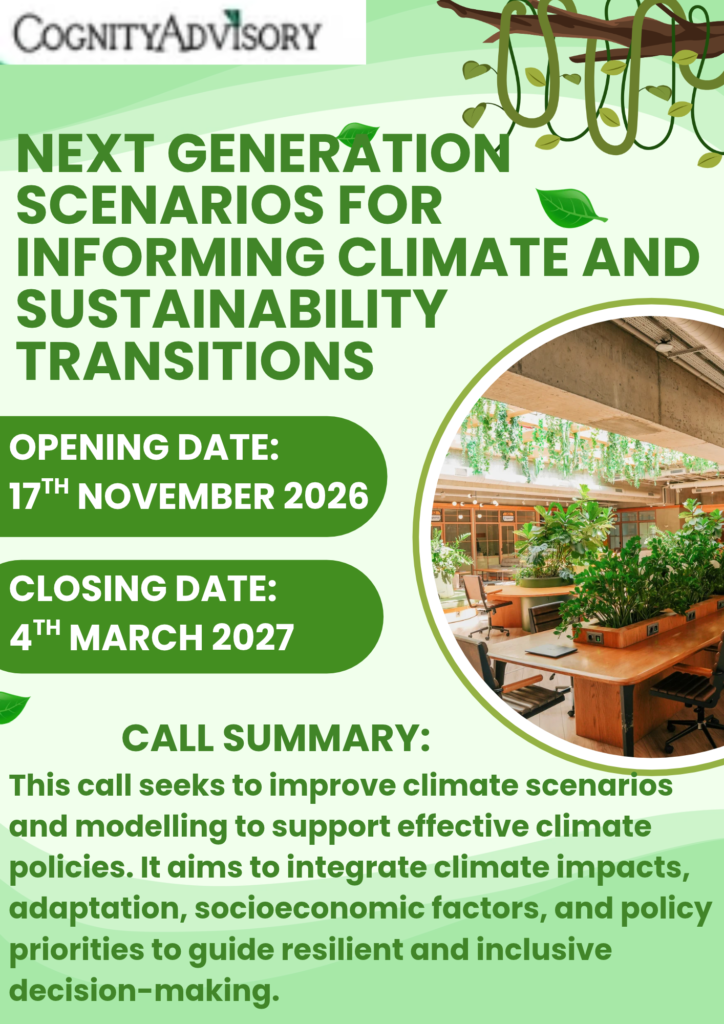
HORIZON-CL5-2027-01-D1-13
General information
Programme
Horizon Europe (HORIZON)
Call
Type of action
HORIZON-RIA HORIZON Research and Innovation Actions
Type of MGA
HORIZON Lump Sum Grant [HORIZON-AG-LS]
Forthcoming
Deadline model
Single-stage
Planned opening date
17 November 2026
Deadline date
04 March 2027 17:00:00 Brussels timeTopic description
Expected Outcome:
Project results are expected to contribute to some of the following expected outcomes:
- Strengthened collaboration and integration across research communities, better capturing interactions and trade-offs between various climate domains as well as between climate and non-climate objectives, such as biodiversity or pollution related. This will support more comprehensive and consistent evaluations, benefiting key global assessments (IPCC, IPBES) and improving their impact on European and global policies (European Green Deal, UNFCCC, CBD);
- More relevant, robust and actionable scenarios that inform optimal policy interventions, serving the needs and supporting decision-making of diverse end-users at various spatial scales, from policymakers and planning authorities to businesses and civil society;
- More globally representative, diverse, inclusive, transparent, widely accepted and better communicated scenarios that support climate-resilient development pathways and foster global consensus on climate action.
Scope:
Climate scenarios have been instrumental in shaping global, national, and increasingly local responses to climate change by helping stakeholders make informed decisions. Against the backdrop of rapid environmental shifts, social upheavals, high uncertainties and complexity, scenarios must be advanced to inform low-emission climate-resilient pathways, while also accounting for other critical policy priorities, such as environmental protection.
Actions should improve Integrated Assessment Models (IAMs) or propose alternative approaches to address key challenges and gaps in current climate scenario frameworks. They should extend the scope of scenarios beyond the 21st century, enlarge the future possibility space with more diverse narratives and drivers (e.g. post-growth), more explicit consideration of equity, justice, geopolitics and attention to inclusivity.
Proposals are expected to address only one of the following priority areas, which should be clearly indicated:
Area A: Integration of climate impacts and adaptation dimension
Develop approaches to better integrate physical climate impacts, adaptation, its costs and limits into mitigation pathways. This includes exploring how climate impacts including extremes and biophysical feedbacks affect mitigation strategies, testing the resilience of low-emission pathways to climate impacts, and how adaptation interacts with mitigation.
Area B: Improved scenario frameworks
Update baseline scenarios and expand scenario narratives to better address multi-scale, cross-sectoral issues and the needs of downstream assessments. Scenarios should capture a wider range of plausible futures to reflect changing socio-economic and environmental conditions (including a broader range of economic growth assumptions), technological advancements, evolving policy landscape and disruptive events. This includes extension of Shared Socioeconomic Pathways (SSP) and Representative Concentration Pathways (RCP) scenario framework, or development of alternatives, to enhance regional and local applicability, to support adaptation pathway development, and to improve relevance beyond the climate research community – notably for biodiversity and SDGs.
Area C: Improved policy representation
Enhance the granularity and diversity of policy (both mitigation and adaptation) representation in scenarios with more focus on implementation aspects to bridge the gap between modelled pathways and real-world action. Address social, geopolitical, economic and technological factors, considering interactions between industrial, trade, climate and other environmental policies (e.g. air pollution). Examine implications for competitiveness, employment, investment flows, energy security, supply chain resilience, technological innovation, international spillovers, as well as well-being. Investigate implementation and impact of recent commitments and initiatives (e.g. fossil fuel phase-out, Global Methane Pledge) and the impact of rising geopolitical tensions on their implementation, and mitigation action overall.