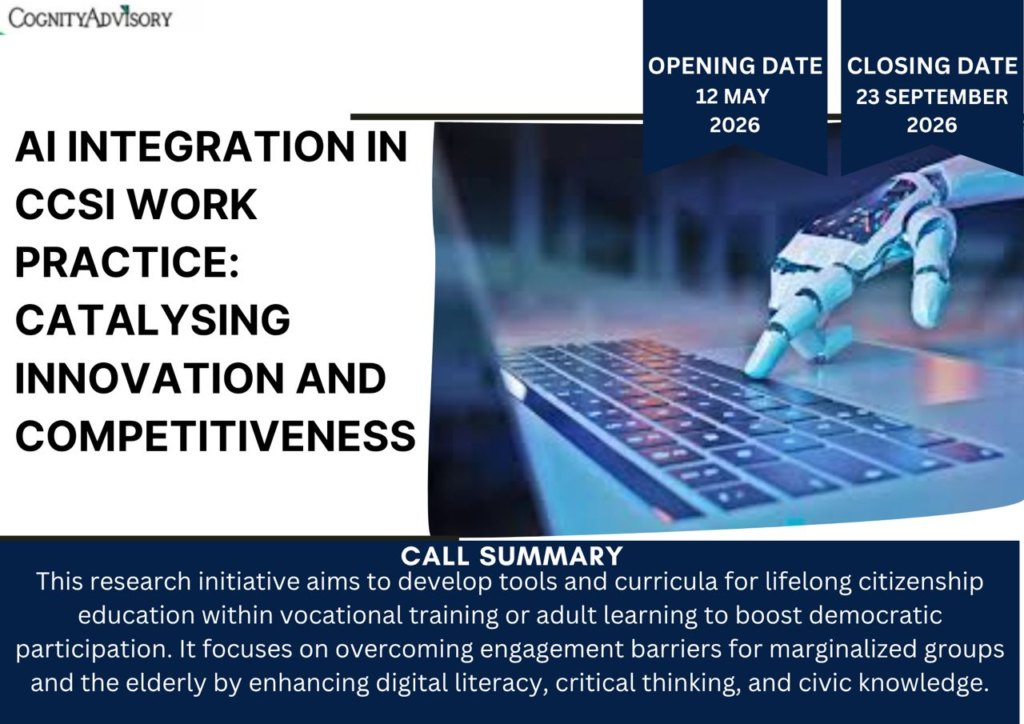
HORIZON-CL2-2026-01-HERITAGE-03
General information
Programme
Horizon Europe (HORIZON)
Call
Culture, Creativity and Inclusive Society 2026 (HORIZON-CL2-2026-01)
Type of action
HORIZON-IA HORIZON Innovation Actions
Type of MGA
HORIZON Lump Sum Grant [HORIZON-AG-LS]
Forthcoming
Deadline model
single-stage
Planned opening date
12 May 2026
Deadline date
23 September 2026 17:00:00 Brussels timeTopic description
Expected Outcome:
Projects should contribute to all of the following expected outcomes:
- Insights, recommendations, strategies, guidelines, methods and tools supporting full AI integration in CCSI practices become available to CCSI, policymakers, and stakeholders.
- Scenarios for co-created solutions tailored to CCSI needs, utilizing quality data and federated data sources, along with digital infrastructures, and inclusive cooperation processes, become available.
- Generally made available AI-powered and ethically designed solutions, tools and services in several CCSI areas benefit creators, cultural professionals, and society, including persons with disabilities and other specific needs, fostering innovative creative expressions and improving creative business models while preserving and enhancing cultural diversity, and inclusion.
- By mastering ethical and inclusive AI, CCSI are empowered drivers of culture, innovation, competitiveness and societal wellbeing.
Scope:
AI technologies are transformative, providing unprecedented opportunities for human creativity, experimentations and co-creations. AI profoundly impacts cultural and creative sectors and industries, changing practices, facilitating new ways of working and making innovative services and products possible. Artists, industry players, and cultural organisations increasingly use AI, for assistance in content creation, production, and management, to predict trends, personalise market content, engage audiences, enhance cultural heritage preservation and accessibility, and many more purposes.
Cultural and creative sectors and industries (CCSI)[1] need to fully harness AI’s potential to maintain relevance, expand their impact and value, increase competitiveness, and keep their vibrant, inclusive nature. Embracing and co-creating ethical AI solutions tailored to CCSI needs will, among other benefits, enable the automation of low-creativity tasks, allowing to increase focus on high-value activities that enhance creativity and productivity, thus unlocking unprecedented possibilities. Production times and costs can be reduced, market reach expanded, preservation, interpretation and inclusive access to cultural heritage enhanced, and new job categories could emerge.
Although several initiatives are on the ground, a comprehensive understanding of enabling frameworks and factors and of what is still lacking in terms of data, standards, infrastructures, computing power, tools, knowledge and capacity for the CCSI to fully embrace the opportunities opened by AI is essential for effectively integrating AI technologies into CCSI practices and workflows. Proposals should assess the current level of AI readiness in the CCSI, investigate the specific barriers to AI adoption in the sectors, and highlight areas where AI can offer the most benefits. In continuous engagement with the sectors, based on the analysis of current practices and through concrete use cases, proposals should produce strategic guidance to extensively and seamlessly integrate AI into CCSI operations, enhancing efficiencies, averting risks, and facilitating cross-sector collaboration. Based on this analysis, they should develop a set of tailored tools designed to address the specific gaps and leverage the opportunities uncovered during the assessment. These tools should be strategically aligned with the sector’s needs, ensuring they provide targeted solutions to enhance AI adoption and maximize its potential benefits. They should be scalable, affordable for smaller, less-resourced CCSI actors and accompanied by related documentation and training materials and documentation.