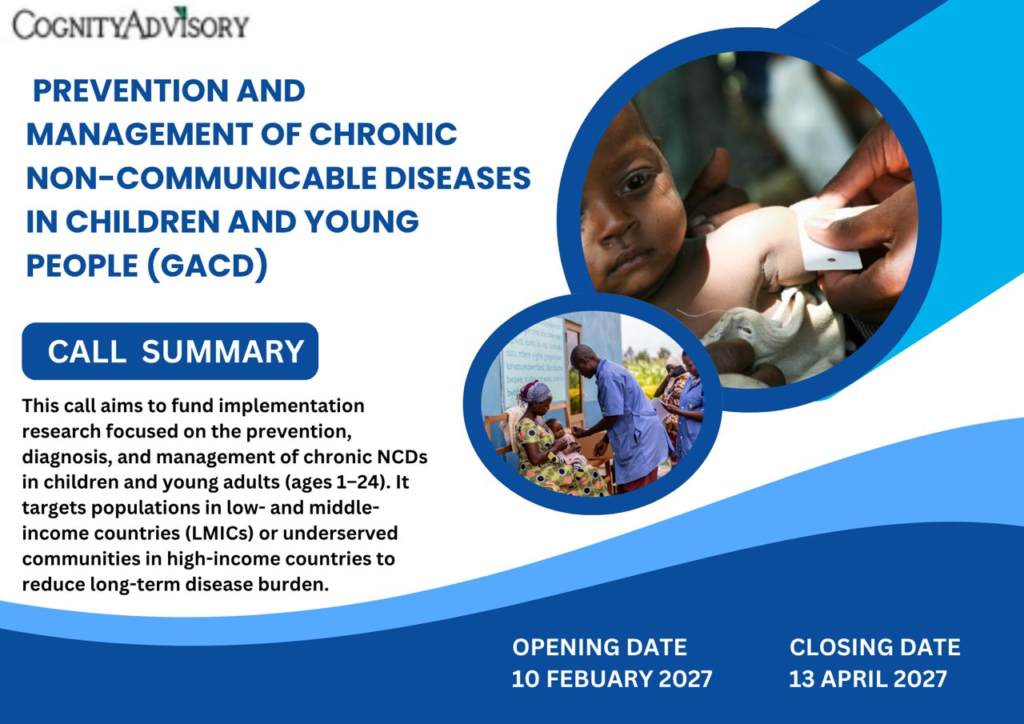
HORIZON-HLTH-2027-01-DISEASE-10
General information
Programme
Horizon Europe (HORIZON)
Call
Cluster 1 – Health (Single stage – 2027/1) (HORIZON-HLTH-2027-01)
Type of action
HORIZON-RIA HORIZON Research and Innovation Actions
Type of MGA
HORIZON Lump Sum Grant [HORIZON-AG-LS]
Forthcoming
Deadline model
single-stage
Planned opening date
10 February 2027
Deadline date
13 April 2027 17:00:00 Brussels timeTopic description
Expected Outcome:
This topic aims at supporting activities that are enabling or contributing to one or several expected impacts of destination “Tackling diseases and reducing disease burden”. To that end, proposals under this topic should aim to deliver results that are directed at, tailored towards and contributing to some of the following expected outcomes:
- Researchers, healthcare practitioners and providers in low- and middle-income countries (LMICs)[1] and/or those in high-income countries (HICs) serving disadvantaged populations have access to improved insights and evidence on how to equitably promote the early prevention, risk reduction, and timely diagnosis of Non-Communicable Diseases (NCDs) in children and/or young people.
- Policymakers, public health managers and authorities, parents and their children, and young adults have access to evidence and recommendations for national programmes and policies to improve quality of life in children and/or young people and extend healthy life expectancy.
- Researchers, clinicians, policymakers, public health managers and authorities have an improved understanding how to effectively adapt and/or scale up interventions for prevention and management of chronic NCDs in children and/or young people at local, regional, and national levels.
- Communities, parents and their children, young adults, local stakeholders and authorities are fully engaged in implementing and taking up interventions that tackle NCDs in children and/or young people.
Scope:
The Commission is a member of the Global Alliance for Chronic Diseases (GACD)[2]. The GACD specifically addresses NCDs and supports implementation research[3] to improve health outcomes. This topic is launched in concertation with the other GACD members (international funding agencies) and aligned with the 12th GACD call.
Chronic NCDs that begin in childhood have an impact on both quality of life and life expectancy. Onset of many NCDs diseases occurs at younger ages in LMICs, and this is further accompanied by a longer duration of disease and a higher rate of complications, including multimorbidity. The conditions in which people are born, grow and live (the social determinants of health) including access to good nutrition, education, housing, and healthcare are major contributors to health and ill health[4].
Up to 70% of preventable adult deaths from NCDs are linked to risk factors originating in childhood and adolescence[5], and interventions that can successfully control or prevent chronic disease in young people can dramatically improve health outcomes later in life. Childhood and adolescence are critical periods, when behaviours associated with NCD risk are adopted including tobacco use, alcohol use, substance abuse, unhealthy diets and sedentary lifestyles and children and young people are often targeted by commercial marketing of unhealthy products.
The aim of this topic is to fund implementation research, exploring strategies, evidence-based program and policy interventions across prevention, diagnosis, screening and management of chronic NCDs, centred on the critical life stages spanning early childhood to young adulthood (1-24 years of age) living in LMICs, and/or underserved populations in HICs.
In this regard, proposals focused on implementation research should explore implementation strategies on evidence-based interventions, adaptations of interventions and tailored interventions, or initiatives including (though not limited to) those focussed on one or more of the following:
- Policy evaluation to tackle childhood- and/or youth-relevant social, economic, political, structural or commercial determinants of chronic NCD conditions.
- Prevention of NCDs using children and/or young people targeted implementation strategies (e.g. educational strategies, vaccination strategies, promotion of behavioural and lifestyle changes).
- Screening and diagnosis of NCDs (or risk factors) in children and/or young people (in particular use of digital tools).
- Cost effective and patient-centred management of NCDs in children and/or young people (including access to medicines and equipment; integrated care pathways; continuity of care for adolescents with existing non-communicable diseases who “age out” of paediatrics, caregiver health and support, citizen science approaches).
Multiple interventions focus on prevention of NCDs in children and young people, yet relatively few have focussed on strategies for management of chronic conditions in these critical life stages, and a limited number of studies have been carried out to study implementation of these in LMIC contexts or with underserved communities. In this instance it would be anticipated that proposals should explore implementation strategies using the appropriate hybrid design study incorporating effectiveness and implementation research outcomes. Therefore, it may be important to undertake formative research as a part of the proposal to support readiness for implementation.
The proposed implementation research should be focused on one or more evidence-based interventions (or complex interventions), providing existing evidence of the intervention’s effectiveness, cost-effectiveness, sustainability, scalability and potential for long-term health and other impacts (and in what context this evidence has been generated).
Applicants should provide rationale and explore the implementation of proposed intervention(s) for a selected study population(s) based in one or more LMICs, and/or underserved populations experiencing health disparities, including Indigenous populations, in HICs, considering the unique social, political, economic, and cultural context(s) in which the study will take place[6]. Applicants should justify why any adaptation will not compromise the known effectiveness of the selected intervention(s).