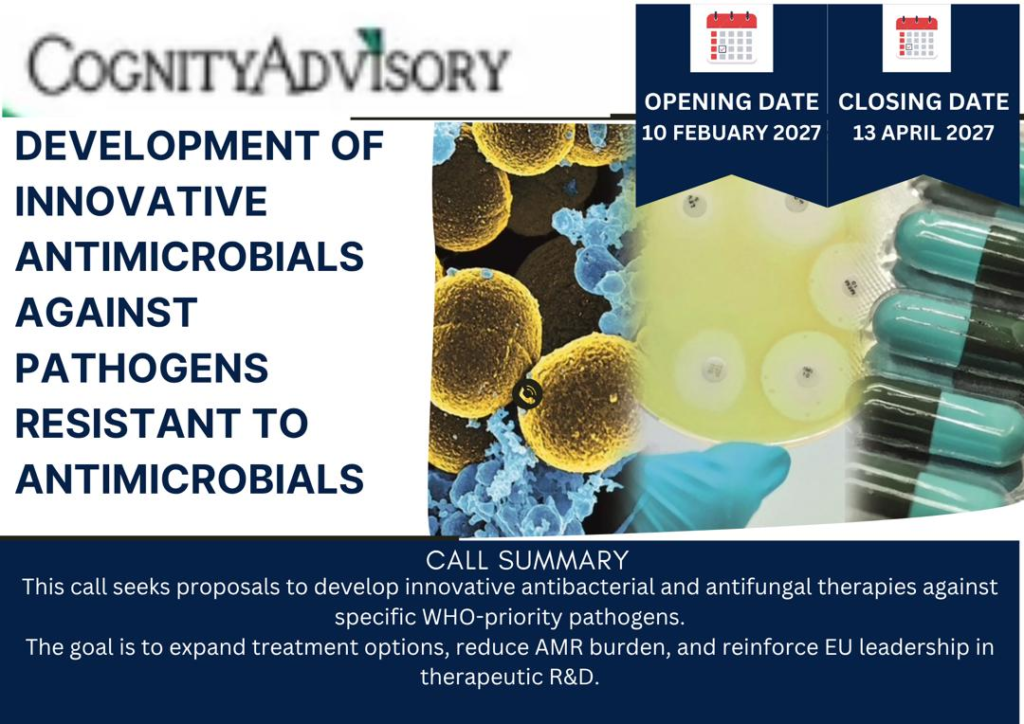
HORIZON-HLTH-2027-01-DISEASE-08
General information
Programme
Horizon Europe (HORIZON)
Call
Cluster 1 – Health (Single stage – 2027/1) (HORIZON-HLTH-2027-01)
Type of action
HORIZON-RIA HORIZON Research and Innovation Actions
Type of MGA
HORIZON Action Grant Budget-Based [HORIZON-AG]
Forthcoming
Deadline model
single-stage
Planned opening date
10 February 2027
Deadline date
13 April 2027 17:00:00 Brussels timeTopic description
Expected Outcome:
This topic aims at supporting activities that are enabling or contributing to one or several expected impacts of destination “Tackling diseases and reducing disease burden”. To that end, proposals under this topic should aim to deliver results that are directed at, tailored towards and contributing to all the following expected outcomes:
- The scientific and clinical communities have a better understanding of and access to new and innovative products for the treatment of antimicrobial resistant bacteria and fungi, as well as for further clinical investigation.
- Candidate therapies are available to treat patients for antimicrobial resistant bacteria and fungi, increasing therapeutic options for clinical deployment in the fight against Antimicrobial Resistance (AMR).
Scope:
The rapid rise of AMR presents a formidable threat to public health, challenging our ability to treat infections that were once easily managed with standard antimicrobials. As pathogens continually adapt and develop resistance to existing drugs, the efficacy of these treatments diminishes, leading to more severe and prolonged illnesses, increased healthcare costs and productivity losses, and higher mortality rates. This escalating crisis underscores an urgent need for viable therapeutic alternatives required to reduce the burden of diseases caused by antibiotic resistance. Innovative solutions are crucial to maintaining effective disease management and safeguarding public health.
Proposals should pursue the development of innovative and effective antibacterial and antifungal agents, including antibody-based therapies, which meet at least one of the four World Health Organization (WHO) innovation criteria[1], namely: i) new chemical class, ii) new target, iii) new mode of action and iv) no evidence of cross-resistance.
This topic contributes to strengthening the Research and Innovation ecosystem within the EU and supports the implementation of the European Medical Countermeasures Strategy[2] and the forthcoming Critical Medicines Act[3].
Proposals under this topic should not pursue the development of phage-therapies.
Applicants should explicitly state in their proposal which of the following pathogens is targeted and the proposed work should address only this specific pathogen. The proposed work should pursue the development of existing therapeutic candidates targeting exclusively one of the following pathogens:
- Carbapenem resistant Acinetobacter baumanii (CRAB)
- Carbapenem-resistant Enterobacterales (CRE) and third-generation cephalosporin-resistant Enterobacterales (C3GRE)
- Carbapenem resistant Pseudomonas aeruginosa
- Methicillin-Resistant Staphylococcus aureus (MRSA)
- (Drug)-resistant Aspergillus fumigatus
- (Drug)-resistant Candida spp
Identifying a specific pathogen does not preclude the exploration of these candidates’ effects on other bacteria or fungi. Proposals should thus aim to accelerate testing of novel candidates in human trials, diversify and accelerate the global prophylactic and therapeutic research and development portfolio for AMR bacterial and fungal infections, and to strengthen the leading role of the EU in prophylactic and therapeutic research and development.
Proposals should address all the following areas:
- If necessary, finalisation of in-vivo tests in at least one animal model or, if available in humanised immune system animal models, to demonstrate the protective function of the therapeutics deemed sufficient for moving to first clinical trials.
- If requested by regulators as pre-requisite for clinical studies, in-vivo tests in a non-human primate model.
- Production of batches of the most promising antimicrobials candidates according to the Good Manufacturing Practices (GMP)[4].
- In human clinical safety and efficacy studies, demonstrating a clear regulatory pathway for market authorisation. Attention should be paid to critical biological and social factors such as sex, age, ethnicity, disability and vulnerability.
Participation of third countries where AMR bacteria and fungi in the proposal are endemic or where outbreaks have occurred or are ongoing is encouraged.
The participation of start-ups, micro, small and medium-sized enterprises (SMEs)[5] is encouraged with the aim of strengthening their scientific and technological foundations, enhancing their innovation potential, and exploring possibilities for commercial exploitation.
All projects funded under this topic are expected to engage with regulatory bodies in a timely manner to ensure adequacy of the actions from a regulatory point of view.
Proposals should advance research by leveraging already existing and emerging state-of-the-art research initiatives such as the co-funded European Partnership on One Health Anti-Microbial Resistance (EUP OHAMR)[6].
Applicants should provide details of their clinical studies[7] in the dedicated annex using the template provided in the submission system. As proposals under this topic are expected to include clinical studies, the use of the template is strongly encouraged.